
Most marketing leaders are not short on ambition when it comes to AI. They're short on structure.
This is why so many AI initiatives feel active but fail to compound. Teams experiment. Pilots show promise. New tools are added. Dashboards multiply. Yet commercial performance barely moves.
The reason is simple. AI does not fix broken foundations. It amplifies them.
If your marketing operation is fragmented, AI will fragment it faster.
If decision-making is slow, AI will surface more data without accelerating action.
If ownership is unclear, AI outputs will be generated and ignored.
AI maturity is not a mindset shift. It is a structural one.
4 structural levers determine AI maturity
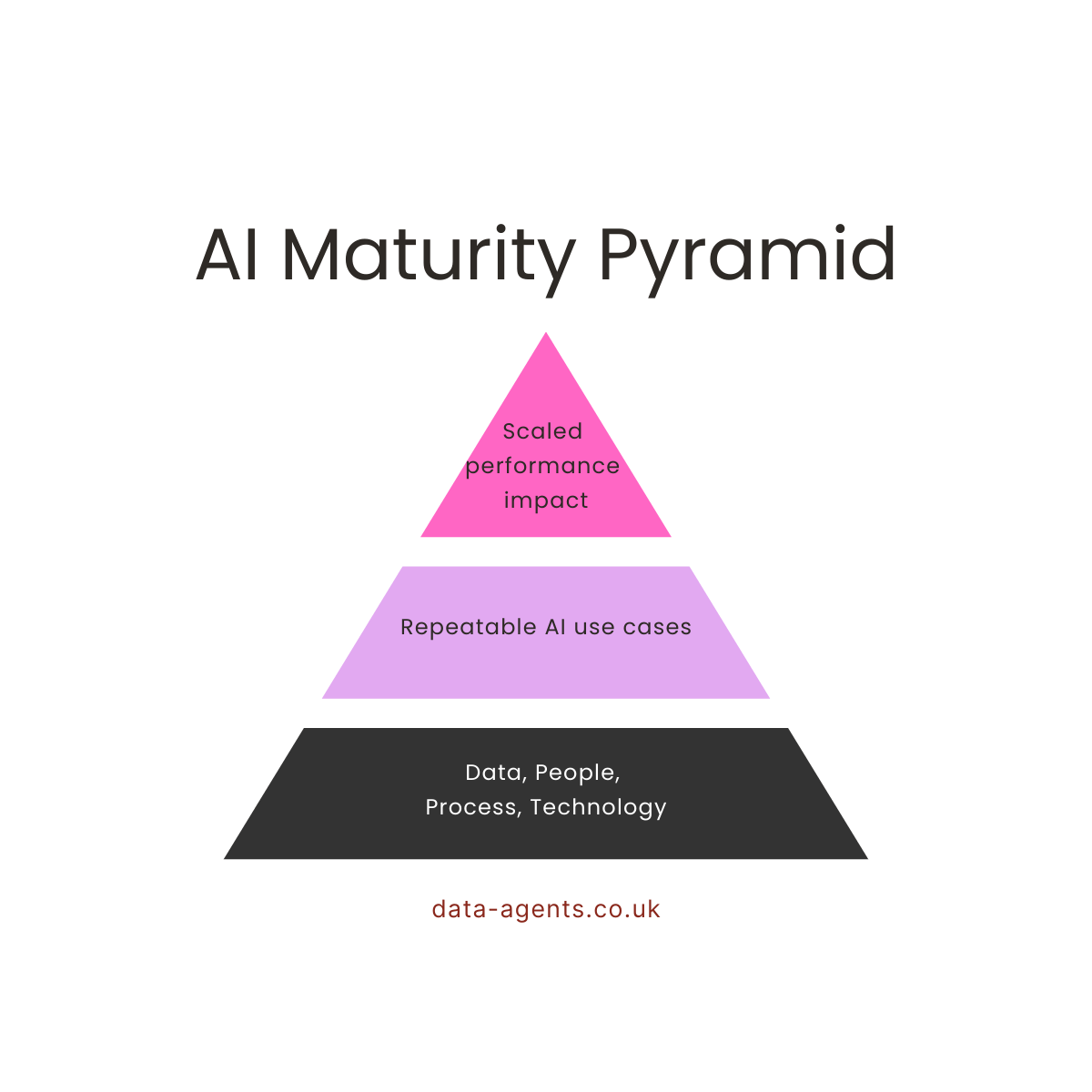
Every marketing organisation progresses through AI maturity based on the strength and alignment of four core elements:
-
Data
-
People
-
Process
-
Technology
Weakness in any one of these caps how far AI can scale, regardless of how advanced the others appear.
Data
AI depends on accessible, reliable and connected data.
Without this, even sophisticated models produce noise rather than insight: personalisation breaks, measurement becomes unreliable, trust erodes.
Common structural issues include siloed platforms, broken tracking, inconsistent schemas and manual data access. These aren't AI problems - they are operational debt.
Until data flows cleanly across channels and teams, AI will struggle to deliver repeatable value.
People
AI adoption fails when it's individual rather than collective.
When AI lives with a few motivated power users instead of inside shared workflows, maturity stalls. Outputs vary, standards erode and results can't be replicated.
Literacy matters. So does trust. Incentives, accountability and clear ownership matter even more.
Process
Process is the most underestimated constraint in AI maturity.
If planning, deployment, QA, testing and reporting are inconsistent or manual, AI introduces risk instead of speed. Automation without process discipline creates fragility.
When processes are unclear, AI accelerates mistakes.
When processes are defined, AI accelerates performance.
Technology
Technology enables scale, but only when it supports the other three.
Tool sprawl, overlapping platforms and brittle integrations slow maturity rather than accelerate it. More tools often mean more friction.
AI-ready stacks are simpler, not more complex.
They prioritise interoperability, automation and reliability over novelty.
Why ambition alone creates false progress
Many organisations believe they are progressing because activity increases.
More pilots. More tools. More dashboards.
In reality, AI maturity increases only when structure improves.
Without structural change:
-
Pilots remain isolated
-
Insights fail to turn into decisions
-
Automation introduces errors instead of efficiency
-
Teams lose confidence in AI outputs
AI becomes a cost centre rather than a capability.
This is why AI programmes stall after early excitement. The ambition was real. The structure was not.
AI scales on structure, not tools
The practical takeaway
Before asking what AI can do for your marketing, ask what your marketing can realistically support.
AI maturity isn't about trying harder or buying smarter tools.
It's about fixing the constraints that quietly limit scale.
This is why readiness diagnostics matter. They surface structural reality before more time, budget, and credibility are spent chasing outputs that cannot compound.
Take our free AI Maturity assessment to apply this framework to your business.